Boa constrictor
The boa constrictor is a large, heavy-bodied snake ranging from northern Mexico through Central and South America, with several regional forms differing considerably in adult size.
Unlike most pythons it gives birth to live young rather than laying eggs.
Common boas typically reach 1.8 to 2.7 metres, with females larger and some mainland forms exceeding three. They are generally calm as adults and tolerate handling well, but a snake of that mass is genuinely powerful, and adults should be handled with a second person present. Twenty to thirty years is normal.
- Origin
- Northern Mexico through Central and South America
- Adult size
- 1.8–2.7 m; some forms larger, females bigger
- Lifespan
- 20–30 years
- Basking temperature
- 30–32°C hot spot, 26–28°C ambient
- Humidity
- 60–70%
- Diet
- Appropriately sized rodents, every 1–3 weeks as an adult
Related: Amazon tree boa · Brazilian rainbow boa
3 boa constrictor photos, newest first
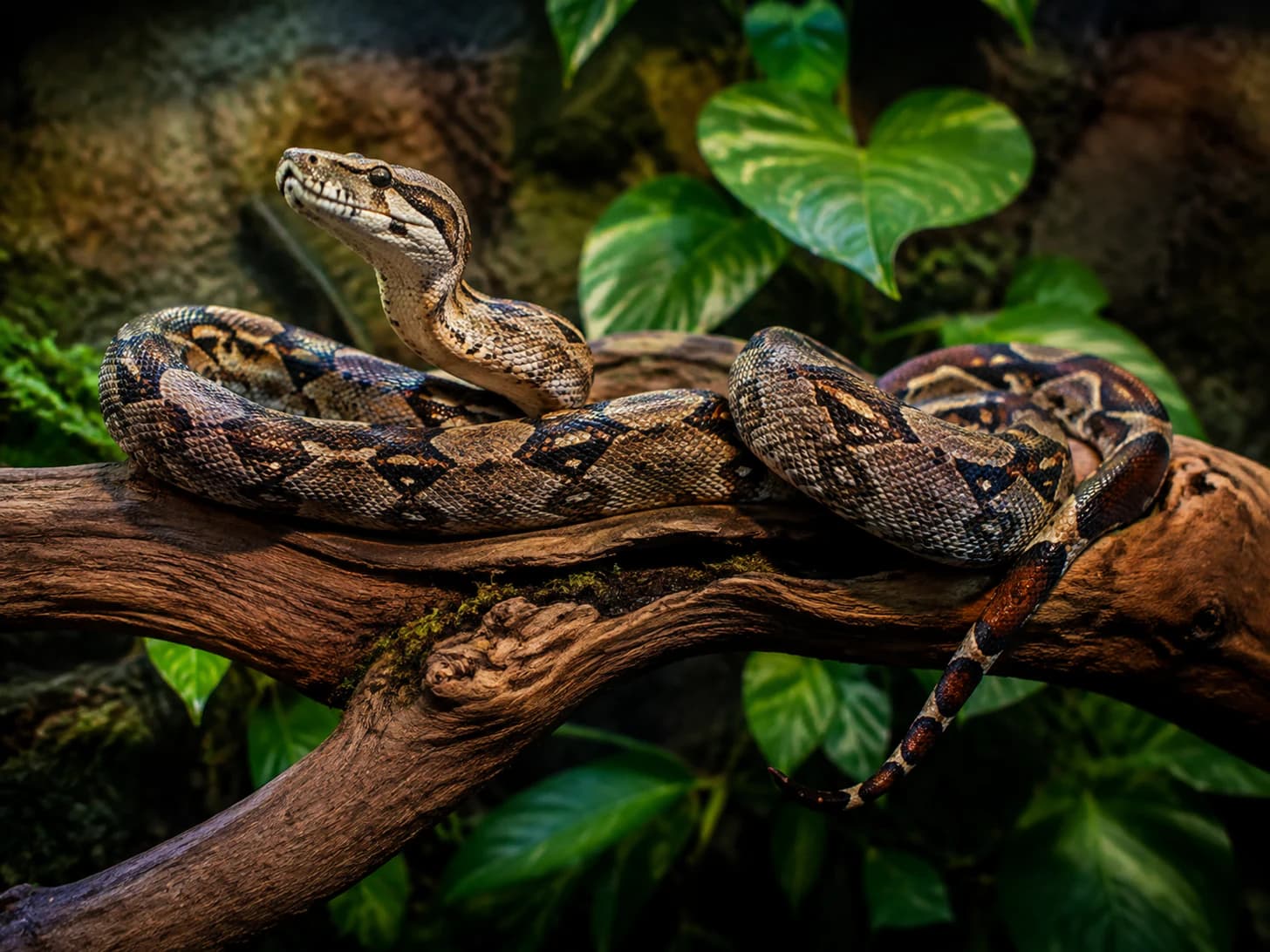



Living with a boa constrictor
Plan for the adult, not the animal in the shop. A hatchling boa is 50 centimetres and a metre-eighty adult needs an enclosure of at least 1.8 × 0.9 metres. Buying a boa is committing to build or buy that.
Handle adults with another adult present. Boas are not aggressive but they are strong, and they anchor by wrapping.
Maintain 60–70% humidity with a large water bowl and a gradient from about 32°C at the hot end to 26°C at the cool. Respiratory infection — open-mouth breathing, bubbling, wheezing — follows cold or damp conditions and needs a vet.
Do not overfeed. Obesity is the commonest health problem in captive boas; an adult eats every two to three weeks, not weekly.
Inclusion body disease is a serious concern in collections; quarantine new arrivals.
General guidance, not veterinary advice. Individual reptiles vary, and anything about a specific animal is a question for a vet who has seen it.
Worth reading alongside this
More reptiles by breed
Every reptile breed somebody has posted a photo of.
- Blue-tongued skink5
- Ackie monitor3
- African fat-tailed gecko3
- Aldabra tortoise3
- Argentine black and white tegu3
- Ball python3
- Bearded dragon3
- Box turtle3
- Brazilian rainbow boa3
- California kingsnake3
- Leopard gecko3
- Amazon tree boa2
- Asian water monitor2
- Black rat snake2
- Blood python2
- Brown anole2
- Bull snake2
- Burmese python2