Ball python
The ball python, Python regius, is a small West and Central African python named for its habit of curling into a tight ball with the head buried when frightened.
In Britain it is the royal python.
Adults reach 1.2 to 1.5 metres, females larger, and thirty years is an ordinary lifespan — animals over forty are documented. They are heavy-bodied, slow-moving and among the most placid snakes kept, which with their size is why they are the usual first snake. The one habit that surprises new keepers is voluntary fasting: a healthy ball python may refuse food for weeks or months, particularly in winter.
- Origin
- West and Central Africa
- Adult size
- 1.2–1.5 m; females larger
- Lifespan
- 30+ years
- Basking temperature
- 31–33°C hot spot, 26–28°C ambient
- Humidity
- 55–65%, raised during a shed
- Diet
- Appropriately sized rodents, every 1–2 weeks
Related: Blood python · Burmese python
3 ball python photos, newest first
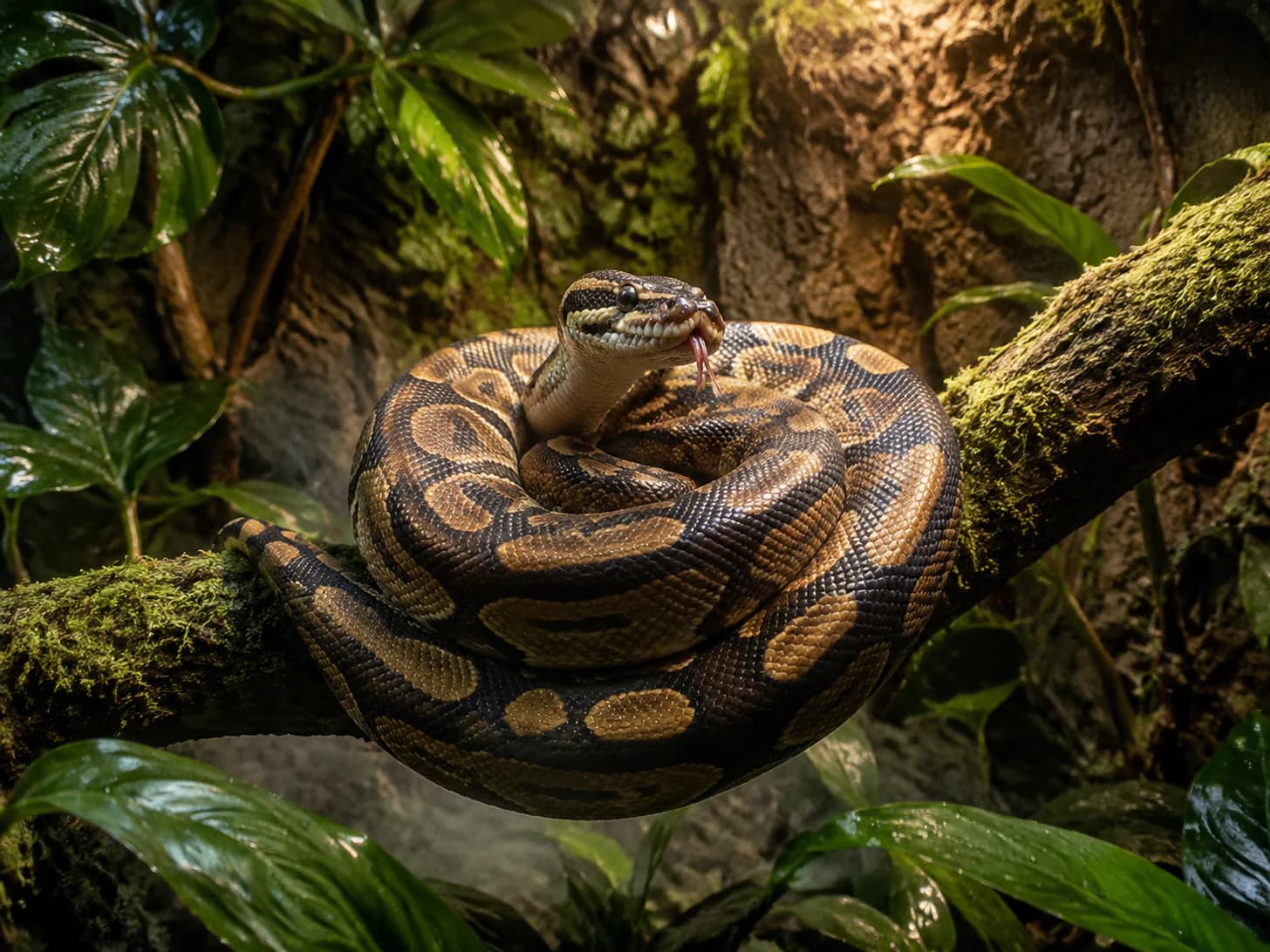



Living with a ball python
Expect refusals. A ball python that skips meals through the winter while holding its weight is behaving normally; weigh it rather than worrying at it, and see a vet if it loses condition. Most feeding problems are actually husbandry problems — too cold, too dry, too exposed.
Provide two tight hides, one at each end, so the snake never has to choose between feeling safe and being the right temperature. A ball python without cover is a stressed ball python.
Humidity of 55–65%, raised towards 70% during a shed. Stuck eye caps and patchy sheds mean it is too dry.
Thirty years is the commitment, and it is the part most often glossed over at the point of sale.
On morphs: the spider morph and several related genes carry a neurological wobble that is inherent to the gene, not a defect in a particular animal.
General guidance, not veterinary advice. Individual reptiles vary, and anything about a specific animal is a question for a vet who has seen it.
Worth reading alongside this
More reptiles by breed
Every reptile breed somebody has posted a photo of.
- Blue-tongued skink5
- Ackie monitor3
- African fat-tailed gecko3
- Aldabra tortoise3
- Argentine black and white tegu3
- Bearded dragon3
- Boa constrictor3
- Box turtle3
- Brazilian rainbow boa3
- California kingsnake3
- Leopard gecko3
- Amazon tree boa2
- Asian water monitor2
- Black rat snake2
- Blood python2
- Brown anole2
- Bull snake2
- Burmese python2