Ackie monitor
The ackie, or spiny-tailed monitor, Varanus acanthurus, comes from the rocky arid country of northern Australia.
It is a true monitor lizard in a manageable size — 60 to 70 centimetres against the two metres or more of its larger relatives — which is why it is often called the dwarf monitor.
It lives fifteen to twenty years, and the appeal is behavioural: monitors are markedly more intelligent than most lizards, they problem-solve, they recognise their keeper, and an ackie is active and engaged in a way a bearded dragon is not. The trade-off is that its requirements are far more demanding, particularly for heat and depth of substrate.
- Origin
- Arid northern Australia
- Adult size
- 60–70 cm including tail
- Lifespan
- 15–20 years
- Basking temperature
- A tight surface hot spot of 50–60°C, ambient 28–32°C
- Substrate
- 30–60 cm of holding soil for burrowing — not optional
- Diet
- Insects primarily, with occasional rodents and eggs
Related: Bearded dragon · Asian water monitor
3 ackie monitor photos, newest first
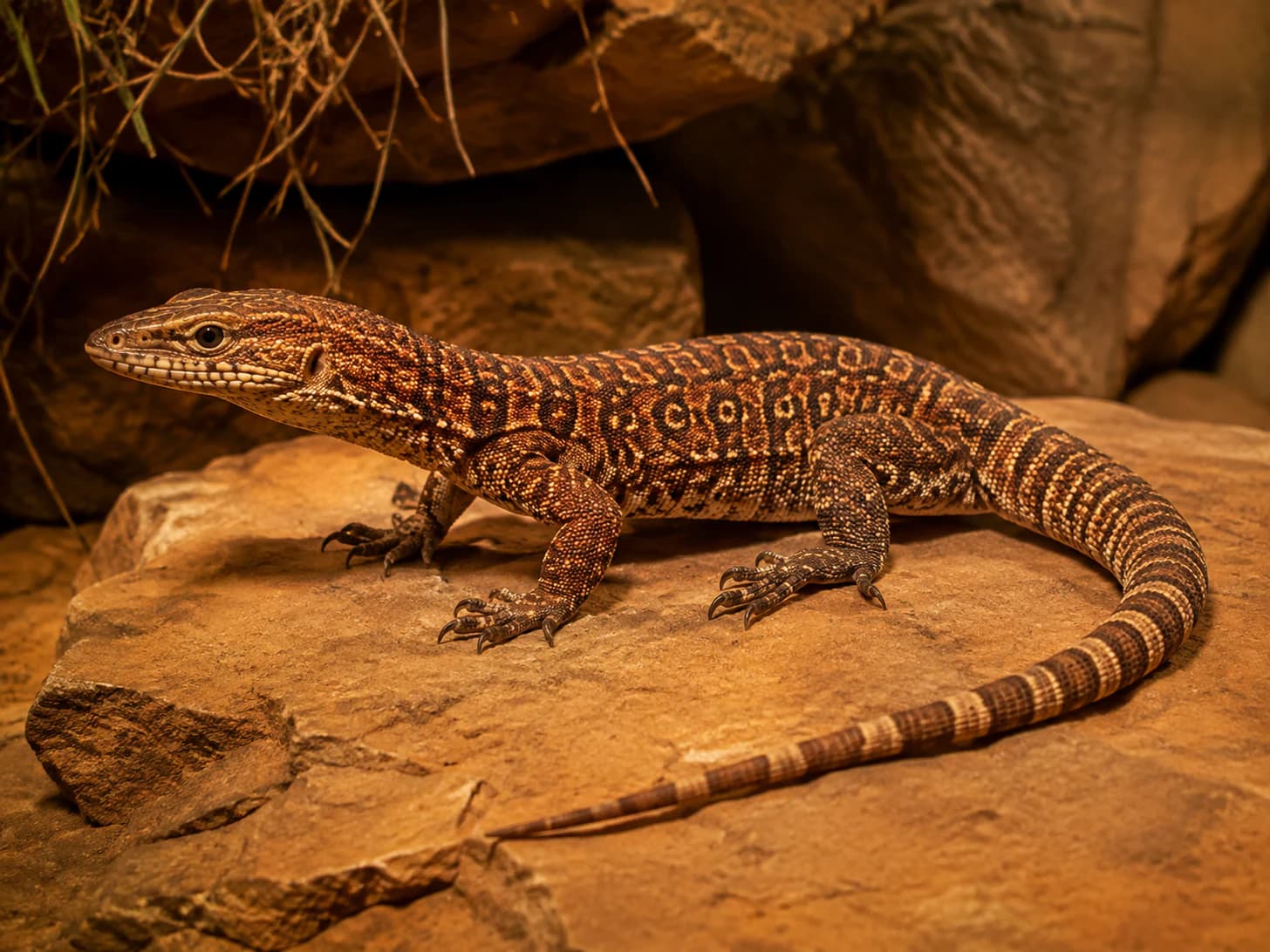


Living with a ackie monitor
Two things make or break an ackie. The first is a very hot, tightly focused basking surface — 50 to 60°C on the rock itself, produced by a cluster of halogen floods rather than a single bulb, over an ambient of 28–32°C. This looks alarmingly hot next to other lizards and it is correct for the species.
The second is substrate. Ackies burrow, and they need 30 to 60 centimetres of a soil and sand mix that holds a tunnel, kept slightly damp underneath. On a shallow bare floor they never behave normally.
UVB across the basking zone, and a large enclosure — 1.2 × 0.6 metres is the floor, more is better.
Feed mainly insects; rodents are a supplement, not a staple, and obesity follows overfeeding them.
They are fast, strong and clawed. Handling is on their terms.
General guidance, not veterinary advice. Individual reptiles vary, and anything about a specific animal is a question for a vet who has seen it.
Worth reading alongside this
More reptiles by breed
Every reptile breed somebody has posted a photo of.
- Blue-tongued skink5
- African fat-tailed gecko3
- Aldabra tortoise3
- Argentine black and white tegu3
- Ball python3
- Bearded dragon3
- Boa constrictor3
- Box turtle3
- Brazilian rainbow boa3
- California kingsnake3
- Leopard gecko3
- Amazon tree boa2
- Asian water monitor2
- Black rat snake2
- Blood python2
- Brown anole2
- Bull snake2
- Burmese python2