Heat, light, and why a heat mat is not a sun
5 min read · Updated
 Reptiles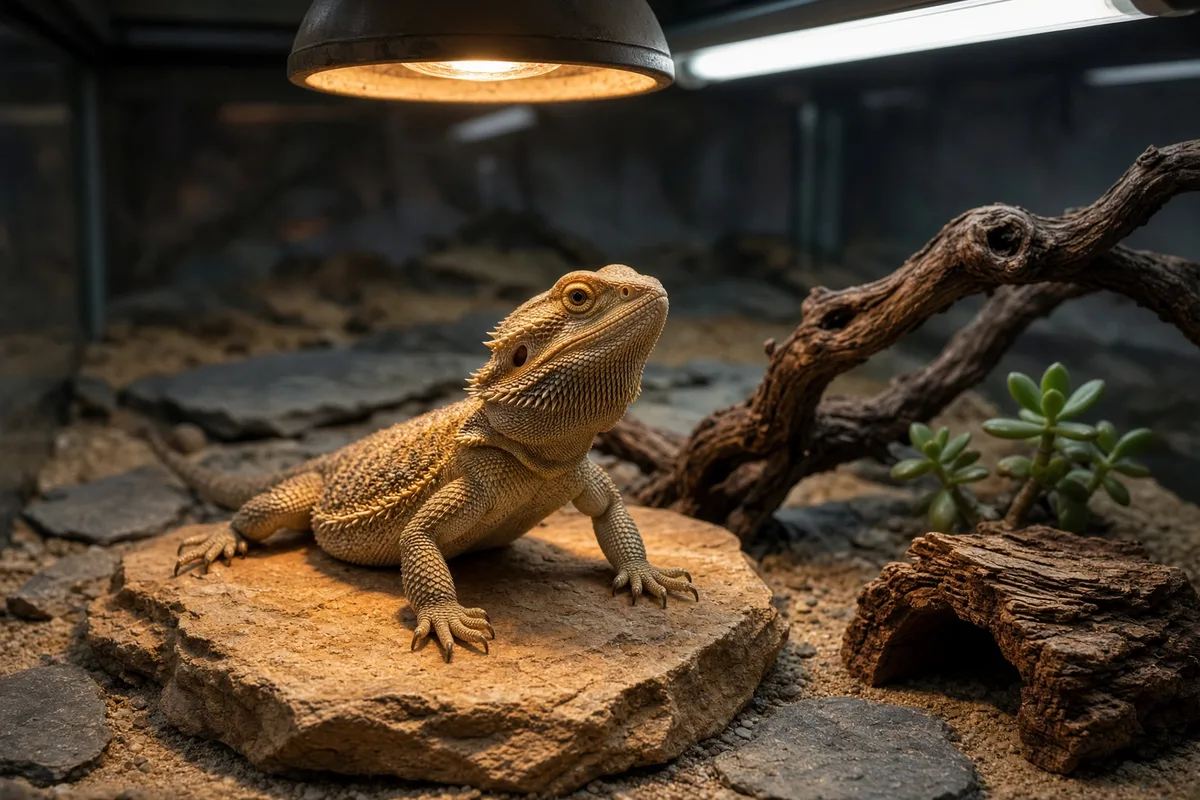
Almost every chronic illness in captive reptiles traces back to the enclosure rather than the animal: a basking spot a few degrees too cool, a UVB tube that has been on for two years, a heat source with nothing controlling it. Get the environment right and most of the rest looks after itself.
A reptile borrows its temperature
A reptile does not produce meaningful body heat of its own. It takes the temperature of its surroundings and moves between warmer and cooler places to land where it wants to be, and everything downstream of that depends on getting there.
Digestion needs a specific temperature range. Below it, food sits in the gut and rots rather than being digested — which is why a cold bearded dragon that has eaten is in real trouble, and why you do not feed a reptile you are about to let cool down.
The immune system needs it too. A reptile kept a few degrees too cool for months is a reptile that gets a respiratory infection and cannot clear it.
So the enclosure has to offer a gradient, not a temperature: a hot end and a cool end, with the animal choosing. An enclosure heated uniformly gives it nowhere to go, and the commonest reason a gradient fails is an enclosure too small to have two ends.
Get the actual numbers for your actual species, from a current care sheet, and write them down — basking surface temperature, warm end, cool end, night-time drop. "Reptiles need heat" is not a specification, and the species sold side by side in a shop want genuinely different things.
Heat from above, and a thermostat on everything
Most basking species want overhead heat, because that is what the sun is. A halogen flood or a deep heat projector above a basking branch or rock creates a hot surface and a warm column of air the animal can climb into.
A heat mat underneath is not a substitute for a basking spot. Mats have a place — for nocturnal, burrowing and belly-heat species, and for some snakes — but a diurnal lizard given only belly heat is being asked to bask on a radiator, and it does not work.
Every heat source goes through a thermostat. Not a timer, not "I'll unplug it if it gets hot": a thermostat with its probe in the right place. Unregulated heat mats and bulbs cause severe burns, and reptiles are poor at moving away from heat that is damaging them because their pain response to it is not ours. A dimming thermostat for bulbs, an on/off or pulse one for mats and ceramics.
Measure the basking surface with an infrared thermometer, not the air with a dial gauge glued to the glass. Those dials are inaccurate by a wide margin and they measure the wrong thing. Add a digital probe thermometer at each end of the enclosure and check both.
No coloured night bulbs. Reptiles see red light, it disrupts their sleep, and most species are fine with a night-time drop anyway — use a ceramic heat emitter if one genuinely needs warmth in the dark.
UVB, and the tube that stops working while still lit
UVB lets a reptile make vitamin D3 in its skin, and D3 is what allows it to absorb calcium. Without it, calcium is taken from the skeleton instead, which is metabolic bone disease: soft jaws, bent limbs, spinal deformity, fractures from nothing, tremors, and eventually death. It is common, it is agonising, and it is entirely preventable.
It is also invisible. UVB output falls away long before a tube stops producing visible light, so a lamp that looks perfectly fine can be doing nothing. Replace fluorescent UVB every six to twelve months according to the manufacturer, and write the date on the tube in marker the day you fit it.
Get the strength right for the species and the distance. A desert species basking a foot below a high-output tube and a forest gecko in a planted enclosure need very different amounts, and too much UVB causes eye damage and burns.
No glass or plastic between the lamp and the animal. Ordinary glass blocks UVB almost completely, which is why a mesh top matters and why a reptile sunbathing behind a window is getting no UVB at all.
Provide shade and cover so it can get out of the UV when it has had enough — the animal self-regulates if you let it.
And a linear tube over much of the enclosure beats a small compact bulb in a corner: it creates a gradient of UV in the same way the heat lamp creates one of temperature.
Humidity, water and the rest of the enclosure
Humidity is the third number, and the one most often ignored. A species kept too dry sheds badly — retained shed around toes and tail tips constricts and costs them, and retained eye caps in snakes are a vet visit. A species kept too damp gets scale rot and respiratory infection.
So measure it with a digital hygrometer, and know the target. A humid hide filled with damp moss lets a dry-kept animal find moisture when it is shedding without making the whole enclosure wet.
Water available at all times, in a bowl big enough for the species, changed daily. Some animals will only drink moving water or droplets, which is what misting and drippers are for.
Substrate appropriate to the species and deep enough to dig in if it digs. Loose substrate is fine for most; the impaction panic is overstated, and the real risk is a fine dusty substrate in a species that needs humidity.
Hides at both ends, so choosing a temperature does not mean giving up cover. A reptile with only one hide, at the warm end, will sit in it whether the temperature suits or not.
Climbing, basking and sight lines for arboreal species — height is usable space for them in a way floor area is not.
And bigger than the minimum, always. Enclosure sizes quoted in shops are floors, not recommendations, and a gradient needs room to exist.