Bedlington terrier
The Bedlington Terrier comes from the mining town of Bedlington in Northumberland, where it was bred to kill vermin and, by repute, to poach.
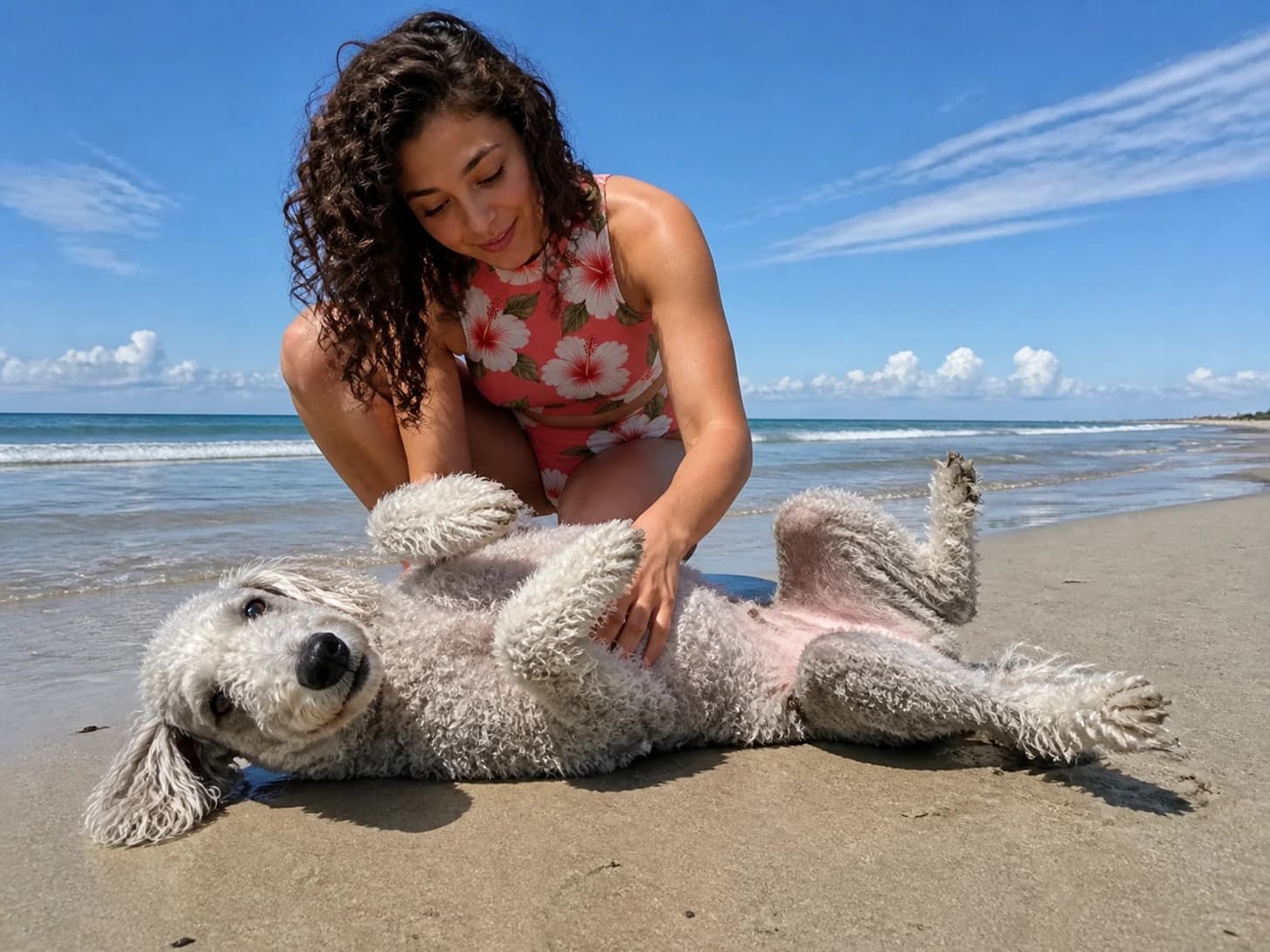
Its lamb-like appearance — an arched back, a pear-shaped head and a curly linty coat — conceals a fast, hard terrier.
It stands 39 to 44 centimetres, weighs 8 to 10 kilograms and lives twelve to fourteen years. The coat is a mix of hard and soft hair that grows continuously and needs clipping rather than shedding. The breed is defined medically by one inherited disease: copper toxicosis, in which copper accumulates in the liver until it causes failure, and which was so common in the breed that its genetics were worked out here first.
- Origin
- Bedlington, Northumberland, England
- Size
- 39–44 cm; 8–10 kg
- Lifespan
- 12–14 years
- Coat
- Curly and linty; grows continuously and needs clipping
- Temperament
- Mild indoors, a hard terrier outdoors
- Health
- Copper toxicosis — a DNA test exists and should be insisted on
Related: Airedale terrier · American hairless terrier · American pit bull terrier · American Staffordshire terrier · Australian terrier
2 bedlington terrier photos, newest first


Living with a bedlington terrier
Insist on the copper toxicosis DNA test. The disease causes copper to build up in the liver until it fails, it is recessive so carriers appear healthy, and the test has been available for years. Testing has reduced the incidence enormously, which is why the test result — not a reassurance — is what a buyer should be looking at.
An affected dog can be managed with a low-copper diet and chelation, but it is a lifelong condition.
The coat does not shed and needs professional clipping every six to eight weeks, plus brushing between.
They are gentle in the house and quite different outside — the prey drive is real, and so is a willingness to fight other dogs if pushed.
Ask also about progressive retinal atrophy and patellar luxation.
General guidance, not veterinary advice. Individual dogs vary, and anything about a specific animal is a question for a vet who has seen it.
Worth reading alongside this
More dogs by breed
Every dog breed somebody has posted a photo of.
- Labrador retriever18
- Afghan hound3
- Airedale terrier3
- Akita3
- Alaskan Klee Kai3
- Alaskan malamute3
- American bulldog3
- American eskimo dog3
- American hairless terrier3
- American pit bull terrier3
- Aussiedoodle3
- Australian cattle dog3
- Australian shepherd3
- Basenji3
- Basset hound3
- Beagle3
- Belgian Malinois3
- Bergamasco sheepdog3
- Bernedoodle3
- Bernese mountain dog3
- Bichon frise3
- Biewer terrier3
- Black and tan coonhound3
- Bloodhound3