Black Russian terrier
The Black Russian Terrier was created at the Red Star military kennel outside Moscow in the 1940s and 50s, from Giant Schnauzer, Airedale, Rottweiler and Newfoundland among others, to produce a large working dog that could cope with the Russian climate.
Despite the name it is not really a terrier.
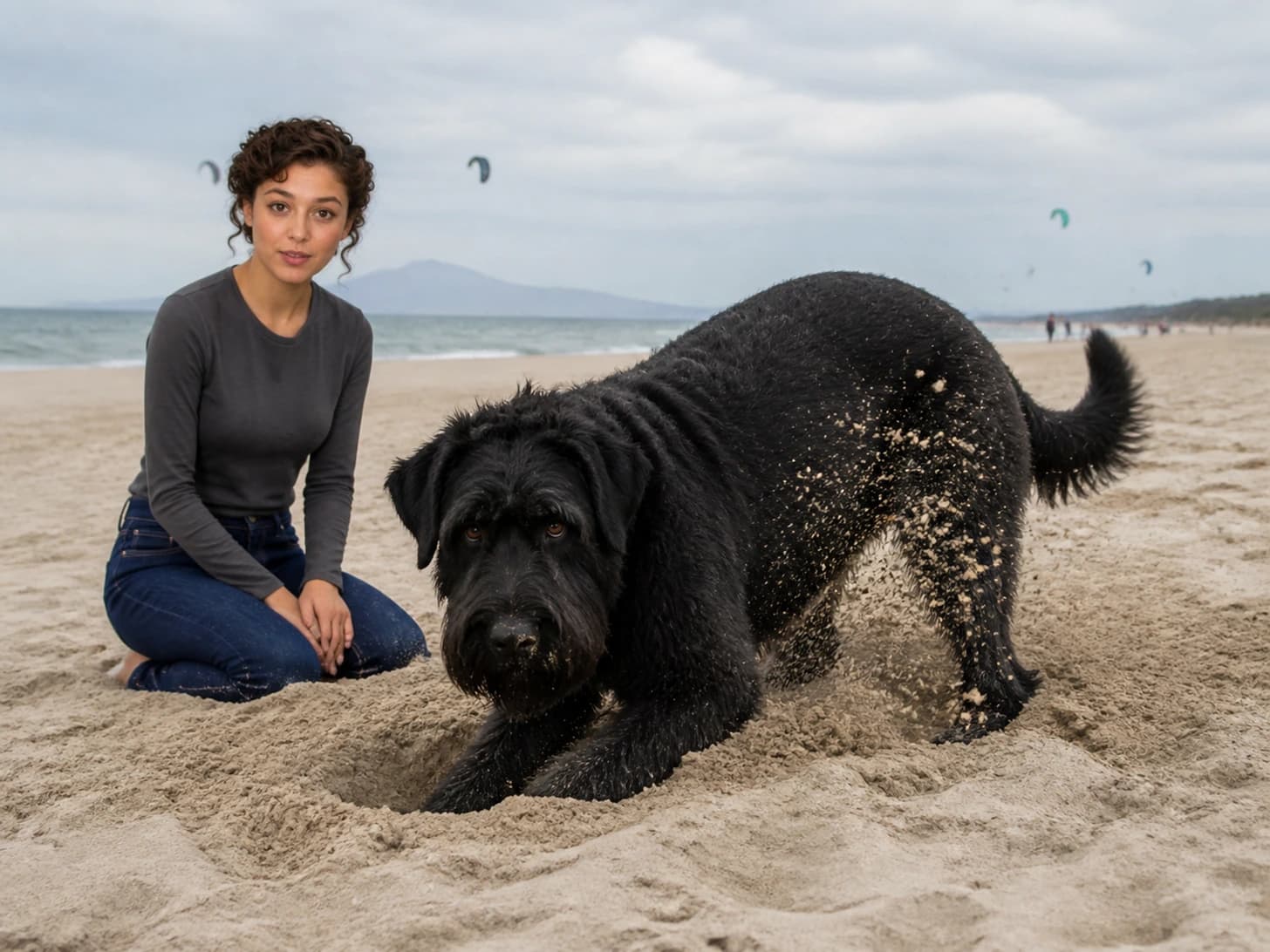
It stands 64 to 76 centimetres and weighs 36 to 60 kilograms, with a dense black double coat and a heavy beard, and lives ten to twelve years. It is a guardian breed — confident, territorial and strongly protective of its household — and it needs an owner who can handle a dog of that size and conviction. It is calm and stable when properly raised, and formidable when not.
- Origin
- Soviet Union, 1940s–50s, at the Red Star military kennel
- Size
- 64–76 cm; 36–60 kg
- Lifespan
- 10–12 years
- Coat
- Dense black double coat with a heavy beard; needs real grooming
- Temperament
- Confident guardian; reserved with strangers
- Health
- Hip and elbow dysplasia; JLPP — DNA testable
Related: Giant schnauzer · Rottweiler · Airedale terrier · American hairless terrier · American pit bull terrier
2 black russian terrier photos, newest first


Living with a black russian terrier
Ask for the JLPP DNA test. Juvenile laryngeal paralysis and polyneuropathy causes puppies to develop breathing difficulty and progressive weakness, and it is fatal. It is recessive, a test exists, and no responsible breeder skips it.
Hip and elbow scores are the other non-negotiable, given the size.
The coat is a serious commitment: brushing several times a week to the skin, and professional grooming every couple of months. The beard needs cleaning after every meal.
This is a guardian, not a family retriever. Early, extensive socialisation and consistent training from a handler who knows large protective breeds is the difference between a stable dog and a dangerous one.
They are strongly bonded and dislike being kennelled or left alone for long.
General guidance, not veterinary advice. Individual dogs vary, and anything about a specific animal is a question for a vet who has seen it.
Worth reading alongside this
More dogs by breed
Every dog breed somebody has posted a photo of.
- Labrador retriever18
- Afghan hound3
- Airedale terrier3
- Akita3
- Alaskan Klee Kai3
- Alaskan malamute3
- American bulldog3
- American eskimo dog3
- American hairless terrier3
- American pit bull terrier3
- Aussiedoodle3
- Australian cattle dog3
- Australian shepherd3
- Basenji3
- Basset hound3
- Beagle3
- Belgian Malinois3
- Bergamasco sheepdog3
- Bernedoodle3
- Bernese mountain dog3
- Bichon frise3
- Biewer terrier3
- Black and tan coonhound3
- Bloodhound3